One Year After DeepSeek: How Low-Cost AI Is Actually Democratizing the Playing Field
A year ago, DeepSeek proved world-class AI doesn't need billion-dollar budgets. Today, that lesson is reshaping everything for small businesses.

Sean McLellan
Lead Architect & Founder

It has been one year since DeepSeek dropped a model that erased $593 billion from Nvidia's market cap in a single day. The Chinese startup proved you could build competitive AI without the billion-dollar infrastructure bills that Silicon Valley treated as table stakes.
The industry called it a fluke. Then it happened again. And again.
Now, according to Reuters reporting from Beijing, DeepSeek's domestic rivals are launching a fresh wave of models timed for China's Spring Festival holiday. The message is clear: low-cost, open-source AI isn't a one-off anomaly. It is the new normal.
Here is what that means if you run a small business.
The Math That Changed Everything
DeepSeek's original breakthrough was straightforward: comparable performance at a fraction of the price. But the real shift came in what happened next.
A RAND Corporation report published last month found that Chinese AI models now operate at roughly one-sixth to one-fourth the cost of comparable US systems. When DeepSeek released its reasoning model R1 in January 2025, the pricing was so aggressive that OpenAI, Google, and Anthropic all cut their rates within weeks.
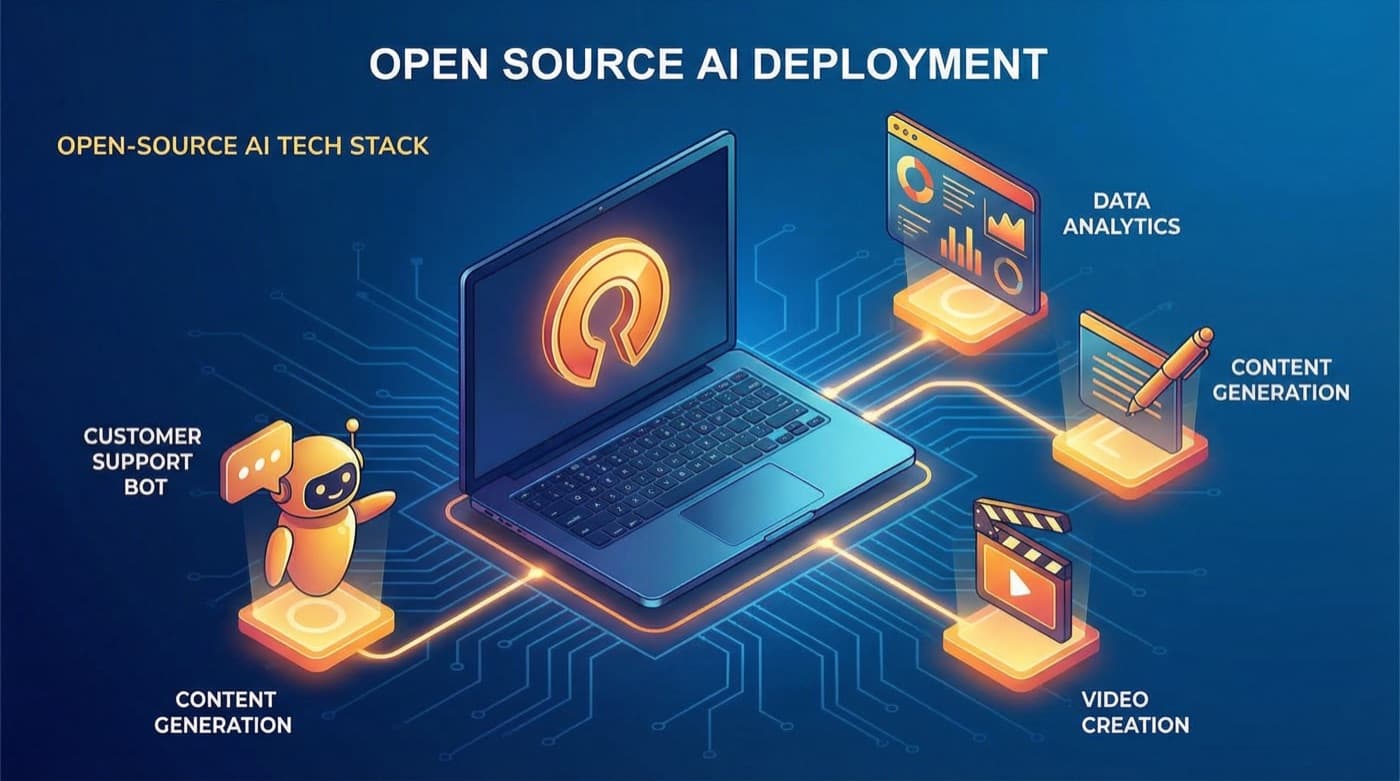
This is not abstract economics. If you are paying for API calls to power a customer service bot, a content generation workflow, or data analysis pipeline, your costs just dropped 70-80%.
More importantly, the price war shows no signs of stopping. Zhipu AI released its GLM-5 model this week with enhanced coding capabilities and autonomous task-running features. ByteDance unveiled Seedance 2.0, a video generation model the company claims can produce "cinematic blockbusters in seconds." Alibaba is preparing its Qwen 3.5 series with improved mathematical reasoning. DeepSeek itself has V4 in development.
Each new release adds pressure to the pricing floor.
Why Open Source Matters for Small Business
Before DeepSeek, serious AI meant proprietary APIs and vendor lock-in. You built on OpenAI's GPT-4, Google's Gemini, or Anthropic's Claude. They were excellent models, but you were renting, not owning.
DeepSeek's open-source approach changed the equation. As Lian Jye Su, chief analyst at tech research firm Omdia, told Reuters: "The combination of open-source access, strong reasoning capabilities and low deployment costs has become a defining model for how Chinese vendors now approach foundation models."
This matters for small businesses in three ways:
First, control. You can run these models on your own infrastructure. No sending customer data to third-party APIs. No worrying about rate limits or service outages.
Second, customization. Open weights mean you can fine-tune for your specific use case. A local bakery training a model on its order history. A consultancy adapting a model to its industry knowledge. The barrier to specialized AI just collapsed.
Third, predictability. API pricing can change overnight. We have seen it happen. When you deploy open-source models, your costs are infrastructure costs, not usage costs. You know what you are paying for.
The Competition Heating Up
The Reuters report notes something interesting: Chinese firms are diverging in strategy. While DeepSeek focuses on pure research, competitors like Alibaba and ByteDance are racing to integrate AI into consumer-facing products.
Alibaba's Qwen chatbot is already experimenting with letting users purchase goods through conversational prompts. ByteDance's Doubao chatbot has 155.2 million weekly active users in China alone, according to QuestMobile data.
For small businesses, this competition is good news. More players fighting for market share means better tooling, lower prices, and more features.
It also means the window for competitive advantage is shifting. If your competitor can deploy sophisticated AI agents for pennies on the dollar, the question is no longer whether you adopt AI, but how well you deploy it.
What to Watch Next
The Spring Festival launches happening this week will give us a preview of the next wave. Three things to pay attention to:
Video generation is moving fast. ByteDance's Seedance 2.0 claims cinematic quality. If the quality holds up, small businesses suddenly have access to video production capabilities that previously required dedicated agencies.
Agentic capabilities are getting real. Zhipu AI's GLM-5 can run long tasks without user prompting. This moves us from chatbots that respond to queries toward systems that actually complete workflows.
Mathematical and coding reasoning keeps improving. The Qwen 3.5 series promises better mathematical reasoning. For businesses dealing with data analysis, financial modeling, or technical implementation, this expands what AI can reliably handle.
The Real Takeaway
DeepSeek's anniversary is worth marking because it validated something important: expensive infrastructure is not a prerequisite for real AI capability.
That lesson has now propagated through the entire industry. The deep-pocketed labs are still building extraordinary models, but they are no longer the only game in town.
For small businesses, this is the democratization we were promised. Not free, but affordable. Not dumbed-down, but genuinely useful. Not locked behind enterprise sales contracts, but available to anyone with the technical chops to deploy it.
The AI landscape one year ago looked like a few giants controlling access to a scarce resource. Today it looks like a competitive market with multiple viable options at dramatically different price points.
That is a meaningful shift. And it is only getting started.
Want practical help navigating the AI options for your business? Contact us for a no-pressure consultation. We help small businesses cut through the noise and find the right AI tools for their actual needs.
AI Pilot Readiness Checklist
Turn the idea into a pilot you can defend.
AI agent articles are easy to bookmark and hard to operationalize. Use the readiness questions as a shared way to decide whether a workflow is specific enough, safe enough, and measurable enough to pilot. If they surface a strong candidate, BaristaLabs can review it with you and help shape a first version that fits your systems, approval process, and risk tolerance.
Please do not submit PHI, customer records, credentials, or confidential workflow exports.
Practical AI Workflow Notes
Want more practical AI operations ideas?
Get short notes on applying AI inside real small-business workflows — from document handling and customer follow-up to internal reporting, compliance, and automation guardrails.