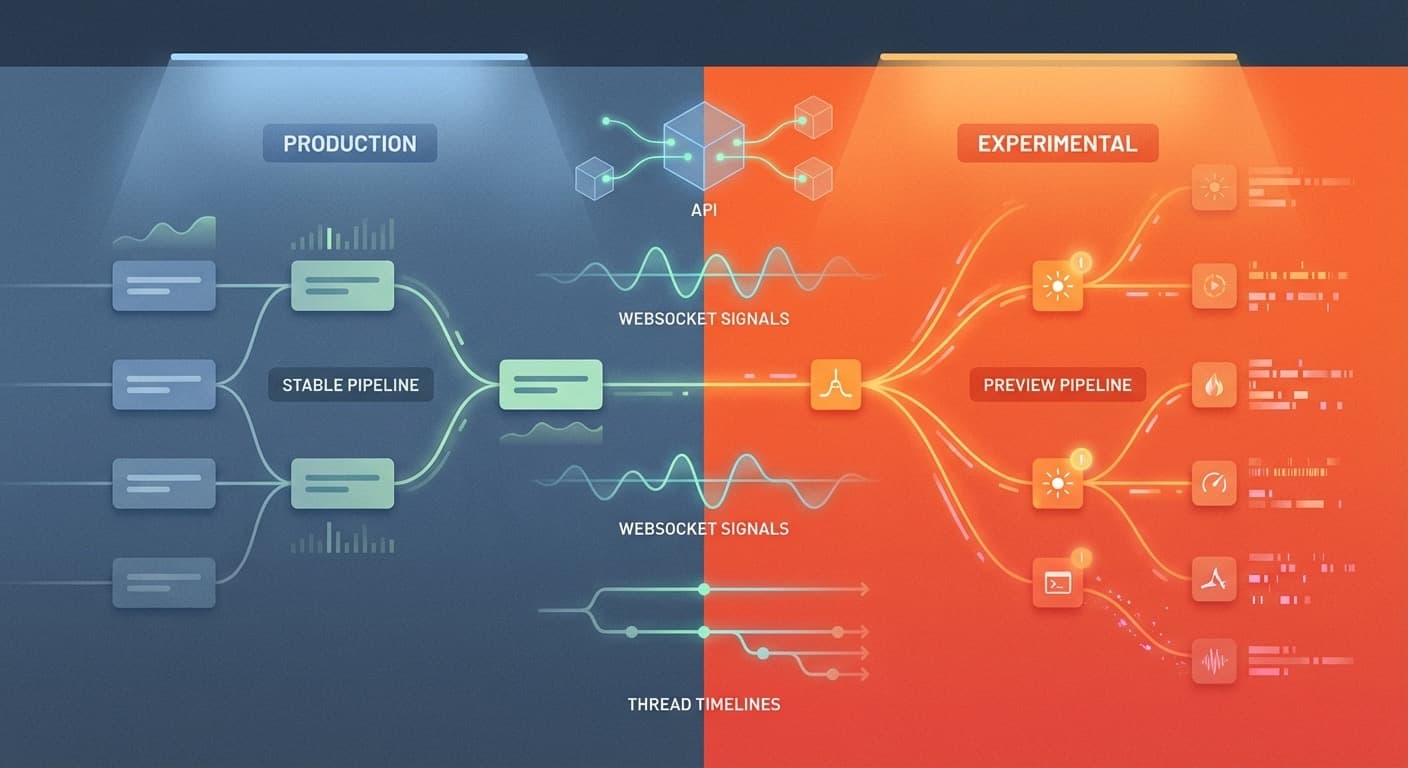

If you run a small agency, this week probably felt familiar: your team finally gets one agent workflow stable, then a stack of release notes lands and everyone asks, "Should we switch now?"
In the last few hours alone, the Codex repo has shown rapid pre-release movement (0.107.0 alpha builds) right after the 0.106.0 production release, including updates to realtime thread APIs, websocket behavior, and install flow (GitHub releases). Pair that with product-side changes in ChatGPT projects and context handling (OpenAI release notes), and you get a classic operator trap: too many new knobs, not enough decision rules.
So here is the practical frame for one operator persona: an agency owner with 6-20 people, client deadlines, and no appetite for weekend fire drills.
This is not about finding the "best model." It is about making three endpoint decisions with clear trade-offs.
For related context, our team has already covered the move from vibe prompts to workflow discipline in From Vibe Coding to Agentic Engineering, plus practical orchestration design in AI Agents for Small Business: Workflow Orchestration.
Decision 1: Stable channel or preview channel for client work?
The 0.106.0 release added meaningful reliability and control features: direct install scripts, thread-scoped realtime endpoints, websocket handshake hardening, input caps, and sandbox path fixes (release details). Those are real production benefits.
But the same release stream also shows rapid alpha churn on 0.107.0 within the same day. That is healthy for velocity, but it should not automatically become your client-facing default.
Trade-off:
- Stable-only policy lowers surprise risk and support burden.
- Preview-first policy can raise productivity faster but increases break-fix tax.
Operator rule: Use stable endpoints for billable client workflows, and allow preview only in internal pipelines with rollback. If your team cannot roll back in under 10 minutes, it is not ready for preview in production.
Decision 2: Realtime thread APIs now, or keep polling architecture?
Codex 0.106.0 expanded app-server v2 with thread-scoped realtime endpoints plus unsubscribe behavior for live threads (GitHub changelog). That matters because polling architectures become expensive and fragile once your team runs many parallel agent tasks.
Trade-off:
- Keep polling: simpler migration path, more predictable debugging, but higher latency and extra orchestration code.
- Adopt realtime threads: better task responsiveness and lower orchestration overhead, but adds event-stream complexity and state-handling requirements.
For an agency owner, the right question is not technical purity. It is margin. If account managers wait on slow status updates, your delivery team burns human time in status pings.
30-minute experiment you can run today:
- Pick one internal workflow with at least 5 agent steps (for example: content brief -> outline -> draft -> QA -> publish checklist).
- Run it once using your current polling setup and measure end-to-end completion time.
- Run it again with realtime thread notifications enabled.
- Compare total elapsed time and number of manual interventions.
If realtime saves at least 10-15% elapsed time with no increase in error rate, move that one workflow to staged rollout next week.
Decision 3: Broader capability now, or environment gating first?
Two updates from recent release notes should trigger governance thinking before feature excitement:
- Compatibility checks around Node baselines and experimental execution features in Codex (release notes).
- Expanded project source ingestion in ChatGPT-style workflows (Slack/Drive/chat artifacts) that can increase context quality but also broaden data exposure surface (OpenAI notes).
Trade-off:
- Enable everything quickly: faster adoption and more visible wins, but wider blast radius when permissions or runtime assumptions are wrong.
- Gate by environment: slower launch, but fewer incidents and cleaner auditability.
Explicit hold-off recommendation: Hold off on enabling new source-ingestion paths (shared drives, broad workspace connectors, or unrestricted chat memory imports) for client accounts until you have per-project data boundaries and a documented retention policy. The capability is compelling, but readiness often lags hype.
A better playbook for next week
Most teams still run rollout decisions backwards: they start from features, then retrofit governance.
Flip that order.
For an agency operator, this is the cleaner playbook:
-
Classify endpoints by risk tier
- Tier 1: stable, client-facing, SLA-bound
- Tier 2: preview, internal delivery
- Tier 3: experimental, R&D only
-
Bind each workflow to one tier Do not let individual contributors pick tiers ad hoc on live client work.
-
Set one promotion rule per tier Example: "Promote preview -> stable only after 7 days, zero critical incidents, and one rollback drill."
-
Track one business metric, not ten technical metrics For agencies: cycle time per deliverable is usually enough to decide whether an endpoint change is worth it.
This is the same operational discipline behind our earlier analysis on why better benchmarks can still fail in production. Better model scores do not matter if your rollout path causes missed deadlines.
Final call
This week did not introduce a single magic model move. It exposed something more useful: deployment governance is now the differentiator.
If you are an agency owner, the winning posture is straightforward:
- stable for client work,
- preview for controlled internal gains,
- experimental for sandbox only,
- and explicit no-go zones until policy catches up.
Run the 30-minute realtime experiment, decide with numbers, and keep the blast radius small. That is how you get faster without getting fragile.
AI Pilot Readiness Checklist
Turn the idea into a pilot you can defend.
AI agent articles are easy to bookmark and hard to operationalize. Use the readiness questions as a shared way to decide whether a workflow is specific enough, safe enough, and measurable enough to pilot. If they surface a strong candidate, BaristaLabs can review it with you and help shape a first version that fits your systems, approval process, and risk tolerance.
Please do not submit PHI, customer records, credentials, or confidential workflow exports.
Practical AI Workflow Notes
Want more practical AI operations ideas?
Get short notes on applying AI inside real small-business workflows — from document handling and customer follow-up to internal reporting, compliance, and automation guardrails.