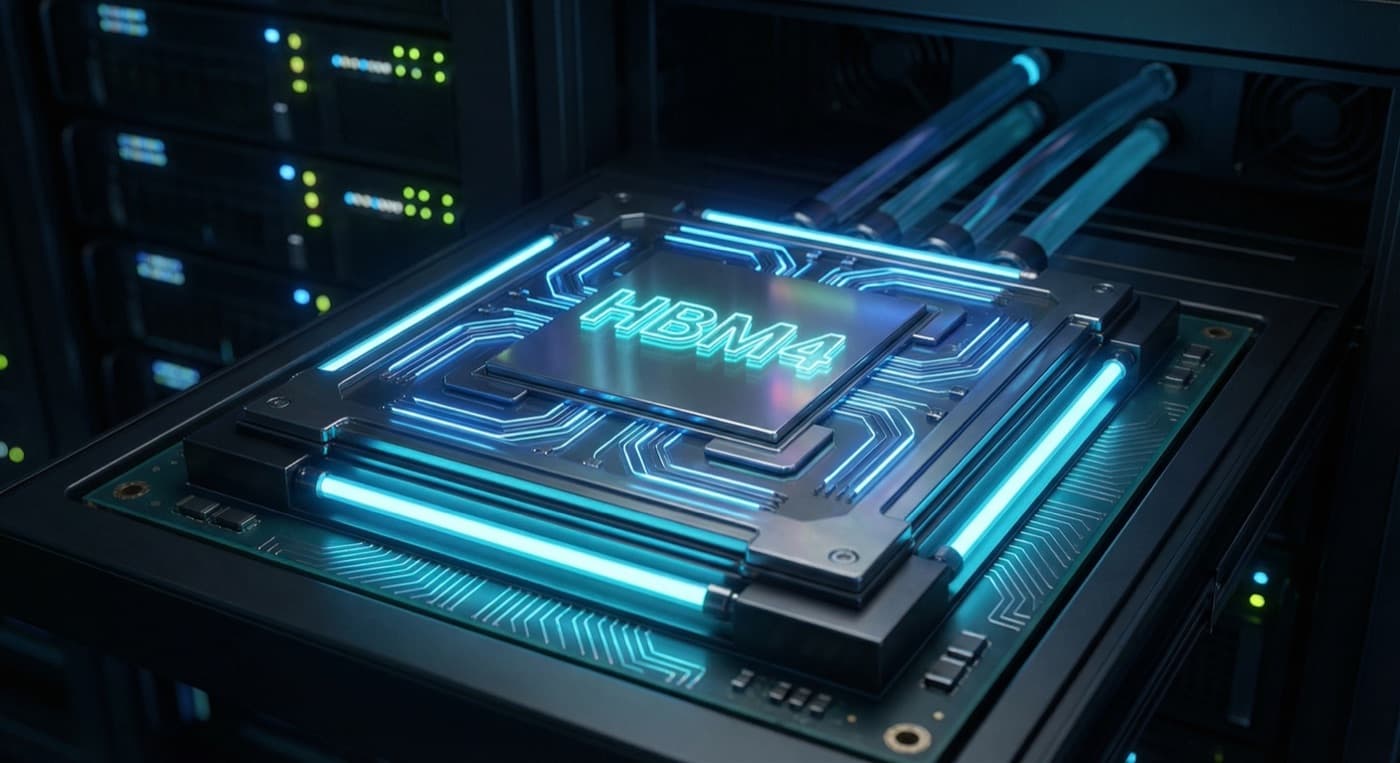

The bottleneck for modern artificial intelligence isn't just compute—it's memory. As models grow exponentially in size and complexity, the ability to feed data to GPUs fast enough has become the primary constraint on performance. Today, that constraint just got a lot looser.
Samsung Electronics announced this morning that it has begun mass production and shipping of its HBM4 (High Bandwidth Memory 4) chips, marking an industry-first milestone that sets the stage for the next generation of AI accelerators.
This isn't just an iterative update. The specifications released by Samsung suggest a massive leap forward in bandwidth and efficiency, directly addressing the "memory wall" that has threatened to slow the pace of AI development.
Breaking the 3 Terabyte Barrier
The headline numbers for HBM4 are staggering. Samsung reports a maximum memory bandwidth of 3.3 terabytes per second (TB/s) per single stack. To put that in perspective, that is a 2.7x increase over the previous HBM3E standard that powers today's leading AI chips.
Processing speeds have also seen a dramatic jump. The new chips deliver a consistent speed of 11.7 Gbps, exceeding the industry standard of 8Gbps by approximately 46%. Samsung notes that performance can be pushed even further—up to 13Gbps—giving hardware architects significant headroom for overclocking and optimization.
For AI labs and data centers, this bandwidth explosion means one thing: bigger models running faster. The ability to move data at 3.3 TB/s allows GPUs to spend less time waiting for information and more time crunching numbers, directly translating to faster training times and lower latency for inference.
Under the Hood: 1c DRAM and 4nm Logic
What makes this leap possible? Samsung took a calculated risk. Instead of sticking with proven, older manufacturing processes, they adopted their most advanced 6th-generation 10nm-class DRAM process (1c) and integrated it with a 4nm logic process for the base die.
"Instead of taking the conventional path of utilizing existing proven designs, Samsung took the leap and adopted the most advanced nodes," said Sang Joon Hwang, Executive Vice President and Head of Memory Development at Samsung Electronics.
This integration of advanced logic directly into the memory stack is a key shift. It allows for smarter power management and data routing within the memory itself. The result is a 40% improvement in power efficiency compared to HBM3E—a critical factor for data centers that are already straining power grids globally.
Capacity for the Trillion-Parameter Era
Bandwidth is only half the battle; capacity is the other. As we move toward trillion-parameter models and beyond, fitting the model weights into memory becomes a massive challenge.
Samsung's HBM4 utilizes 12-layer stacking technology to offer capacities ranging from 24GB to 36GB per stack. They have also confirmed a roadmap for 16-layer stacks, which will push capacity up to 48GB.
For a typical AI server with 8 GPUs, stepping up to HBM4 with 48GB stacks could mean hundreds of gigabytes of high-speed memory available directly to the compute engines. This density is essential for running massive "mixture of experts" (MoE) models and long-context reasoning agents without constantly shuffling data back and forth from slower system RAM or SSDs.
The Road Ahead: HBM4E and Custom Silicon
Samsung isn't stopping here. The company outlined an aggressive roadmap for the next 18 months:
- H2 2026: Sampling begins for HBM4E, the extended version likely pushing speeds and efficiencies even further.
- 2027: Custom HBM samples will start reaching customers.
The mention of "Custom HBM" is particularly intriguing. It suggests a future where hyperscalers (like Google, Microsoft, and Meta) and chip designers (like Nvidia and AMD) can work with Samsung to bake specific logic or features directly into the memory stack, further blurring the line between compute and memory.
What This Means for Business
While HBM4 is a component deep inside the server rack, its impact will ripple out to every business using AI.
- Lower Inference Costs: Higher bandwidth and efficiency mean fewer GPUs are needed to serve the same number of users, potentially lowering the cost per token for API providers.
- Smarter Models: The capacity increase allows for larger, more capable models to be deployed in production, not just in research labs.
- Real-Time Capabilities: The massive bandwidth boost is crucial for real-time multimodal AI (voice, video, and text simultaneously), which requires moving vast amounts of data instantly.
We've discussed the massive infrastructure boom fueling these developments, and HBM4 is the fuel injection system for that engine. As companies look to build modern AI foundations and deploy top AI tools, the hardware layer remains the ultimate enabler of software innovation.
Samsung has thrown down the gauntlet. Now, it's up to the chipmakers and model builders to use this speed to build what's next.

Source: Samsung Global Newsroom
Turn this idea into a pilot
Which workflow should go first?
Use the readiness check to compare impact, effort, risk, owner, and next step before requesting a review.
- 3-5 minutes
- Deterministic score
- No sensitive data
Practical AI Workflow Notes
Want more practical AI operations ideas?
Get short notes on applying AI inside real small-business workflows — from document handling and customer follow-up to internal reporting, compliance, and automation guardrails.